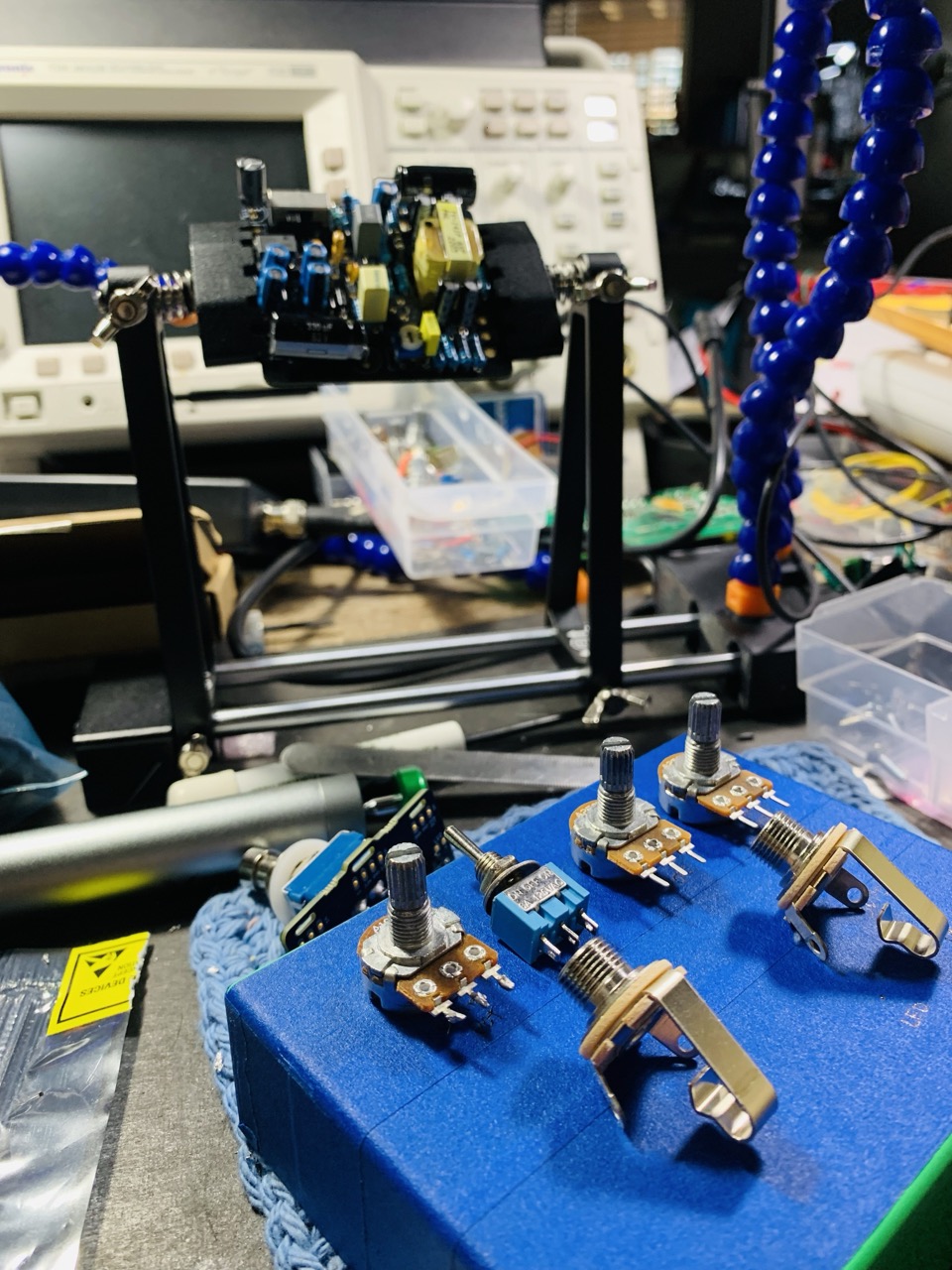
TL; DR
Built a Hudson Broadcast clone guitar pedal from AionFX with some stock schematic modifications along with a custom clipping section and it turned out remarkably awesome and nails early Deep Purple, Black Sabboth, Thin Lizzy, Led Zeppelin to Ted Nugent!
This pedal is just an absolute must of a build with hardly any un-obtain-ium part(s) (unless you used what I used), read on!
Back Story
I've been on a grandiose guitar pedal building saga build out some really killer, customized gain stacked "classic 70's rock" tone setups for my pedal board that are primarily transistor only (silicon can's or germanium anything).
I'm not chasing any particular "tone" but there is something to be said about transistors-of-old based overdrive and into distortion (let's clarify, on the distortion-side of fuzz). For whatever reason, that tone is in a category to me that just sounds far superior and authentic; there's just this compressed, raw edge sonically I can't describe other than if you were listening to me A/B that kind of guitar pedal tone specifically, and I said, "That." Then you'd know.
One that's always had my attention lately in the promising department is the Hudson Broadcast from Hudson Electronics in the UK. It's advertised as a "Class-A germanium pre-amplifier" with a "wide range of driven and distorted tones whilst remaining dynamic, responding well to pick attack and the subtle nuances of every player".
I definitely did my best "Youtube" demo education to see what I was getting into; there's plenty of them, good, bad or otherwise --- but enough wading proved it was worth a build, let alone: no crazy parts list and at least (Hudson Electronics perspective), driving the gain stage with a modern germanium from what I was able to find when researching.
Below in the resources section, you'll see which one's I remember cherry picking to make sure I was in the ballpark for sound.
To be honest, anything "Germanium" has my attention, plus it's all transistor based, so I'm in.
The Build
What else is there left to do? Let's get on with what I did for a build!
Schematic + Parts List
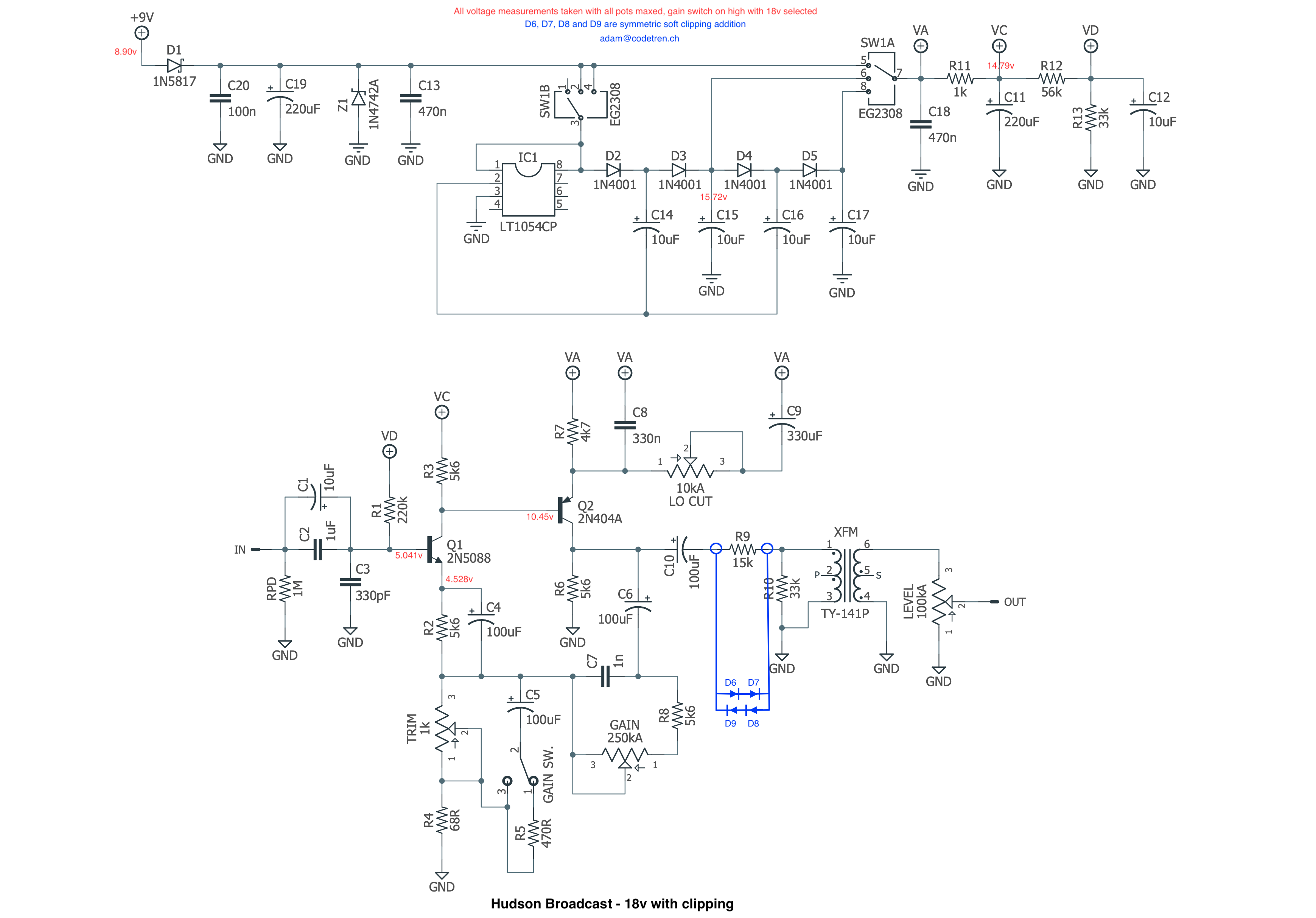
Here is the direct link to the Hudson Broadcast clone 'Skywave' (AionFX) and the part(s) list + PCB. Below is my small changes outlining the symmetric clipping:
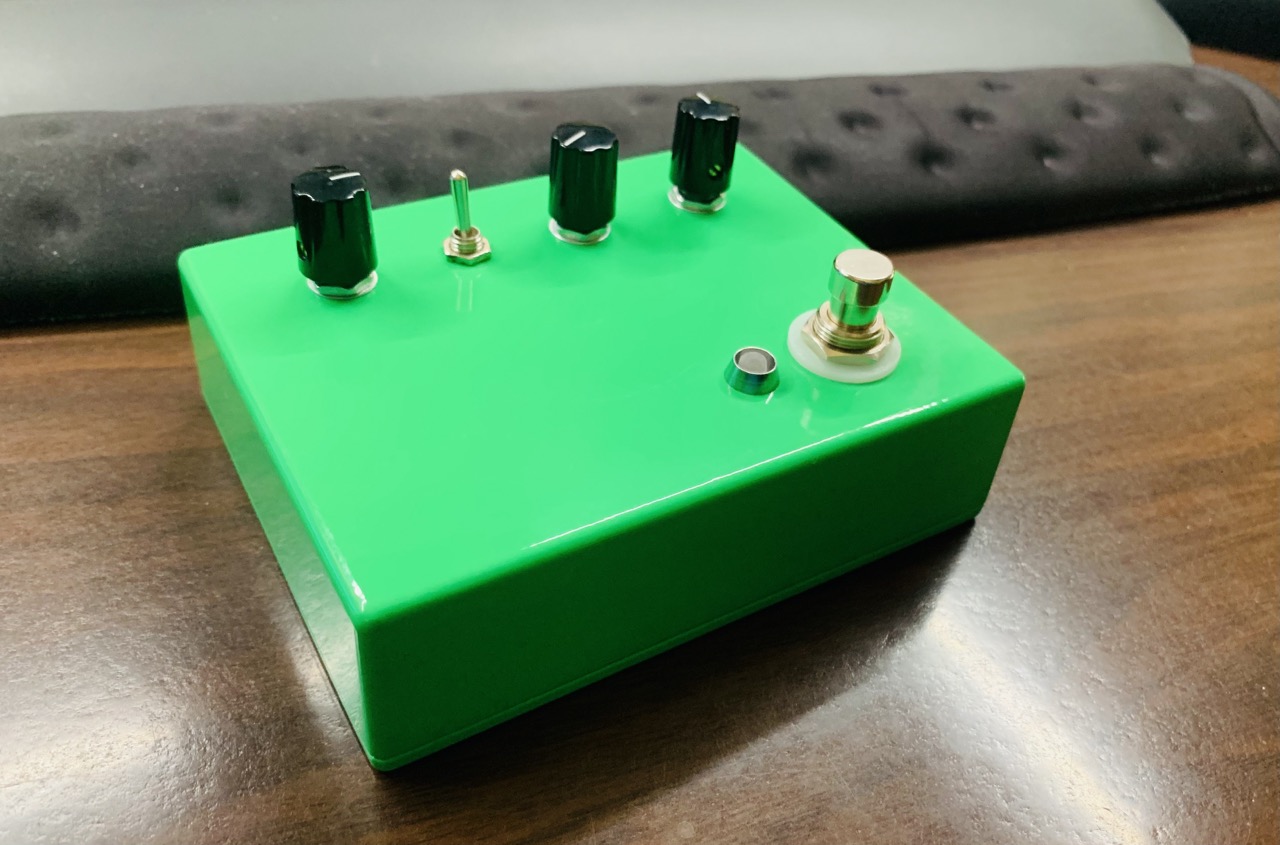
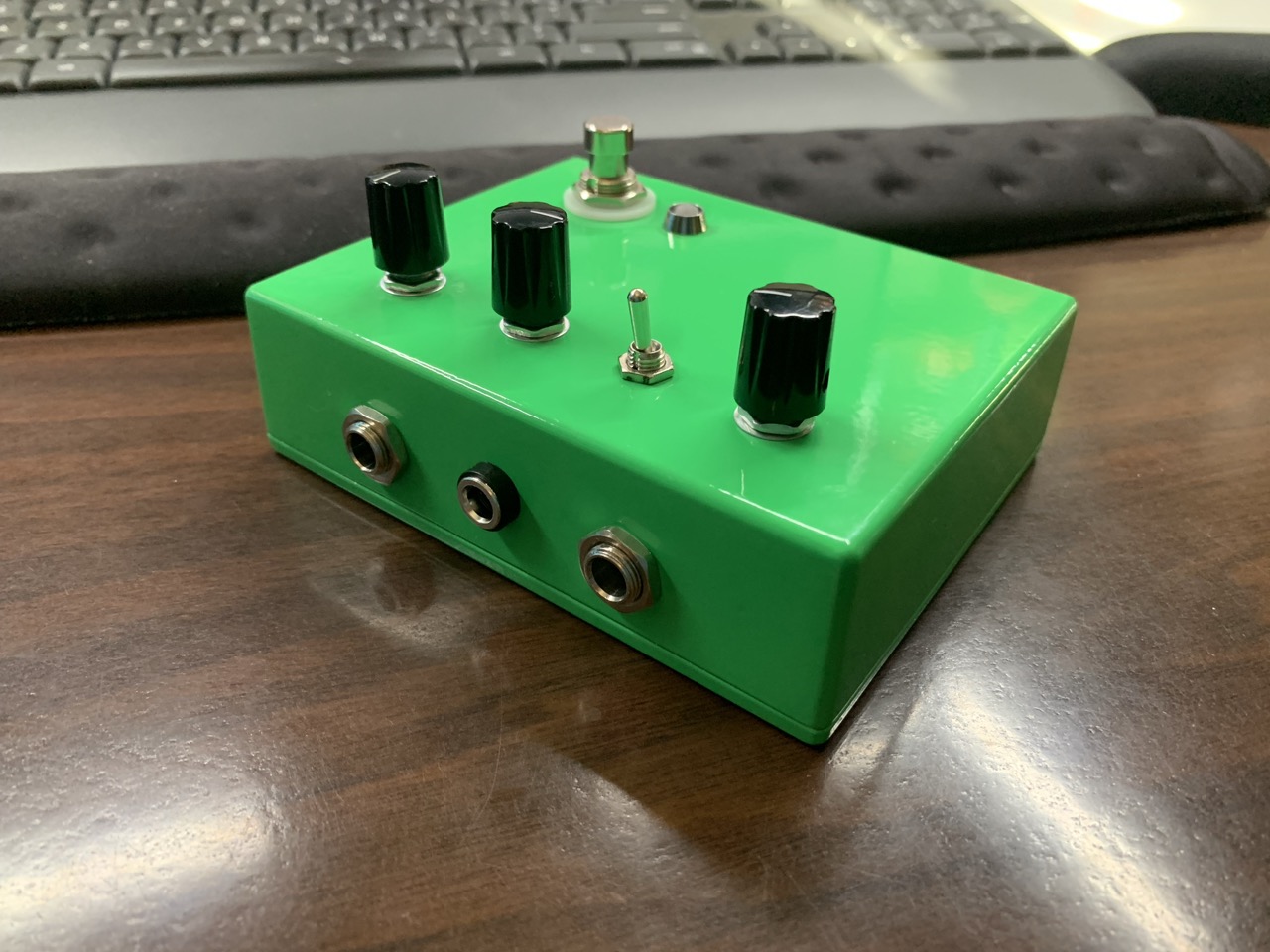
For enclosure, I used Sea Green Hammond-like 1590BB from amplifiedparts.com -- just to match that Hudson Electronics pedal look in spirit!
For knobs, I used what I had on hand - scalloped edge set-screw knob (Daves 1900 clone) from amplifiedparts.com
Changes and Customization(s)
Below are my changes to the provided schematic, along with notations explaining decision point(s):
Part    Value (Orig)   Value (New)    Notes
C1      10uF           OMITTED        Per build notes, used C2 1uF film for coupling
C2      1uF
C3      330pF          680pF          Used what I had for AC/RF filtering.  Didn't
                                      want to do in-series capacitors
C11     120uF (35v)    330uF (35v)    Only had 330uF (35v) on hand, largely for
                                      power filtering

Q1      BC549          BC547C         BC547C only on hand and hfe=513 which met
                                      measured teardown specs
Q2      2N404A         1T320B         1T320B (hfe=80) from preference; by ear.  2N404A
                                      (hfe=233) was super gainy, buzzy-fuzzy and really
                                      treble forward

Q2(2)   2N1307                        (hfe=61, vF=316mV) closest, by ear and sonically, to the
                                      1T320B, plus being modern germanium

Q2(3a)  2N508                         (hfe=94, vF=364mV) decent fill-in, missing some edge
                                      and harmonic richness 1T320B and 2N1307 have
Q2(3b)  1T403A                        (hfe=48, vF=122mV) decent fill-in, missing edge and
                                      harmonic richness, and also a bit mid-rangey/dull

LEVEL   100kA          250KA          Hudson Broadcast teardown video shows LEVEL at 250KA,
                                      some pedal schematics show 25KA or 100KA

LED     Red 5mm        UV 5mm         No technical reason
LEDR    10k            10k trimmer    Started doing this with more builds to tweak/adjust LED
                                      brightness across my pedal board

Voltage  9V            18V            Out of all modes (9/18/24V), this just shined overall in tone,
                                      operability and playability across the board.
All modern germanium(s) were obtained from amplifiedparts.com
My customization (explained more below) is adding a soft, symmetric clipping section post gain stage and prior to transformer, across R9:
Part    Value        Notes
D6      D312B        Russian diodes (from eBay), paired directionally in-series with D7, vF=0.215mV
D7      D213B        Russian diodes (from eBay), paired directionally in-series with D6, vF=0.215mV
D8      D213B        Russian diodes (from eBay), paired directionally in-series with D9, vF=0.217mV
D9      D213B        Russian diodes (from eBay), paired directionally in-series with D8, vF=0.217mV
If you're interested in what the D312 diode(s) are or look like, here it is. Obtained from ebay.
Design & Layout
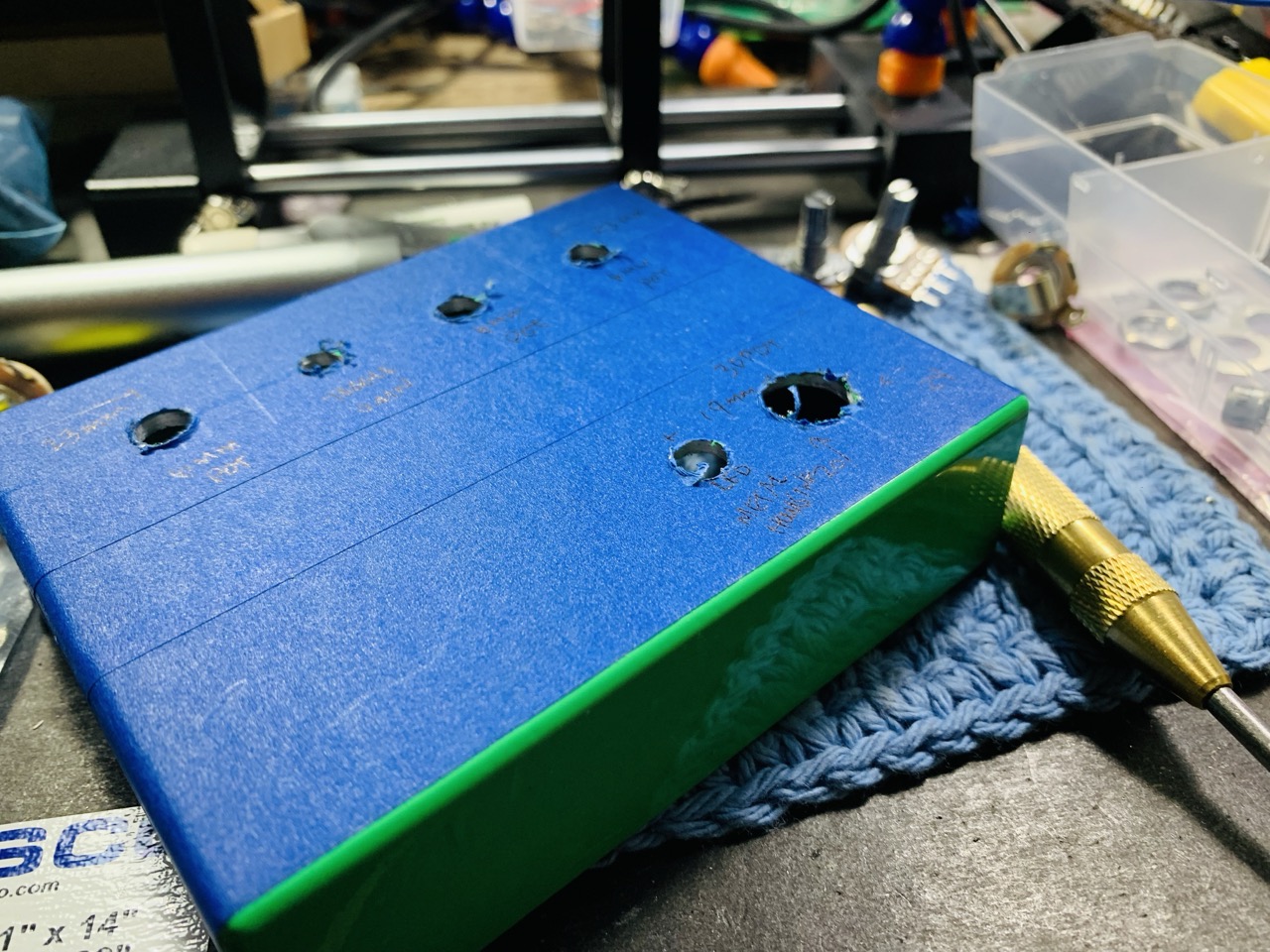
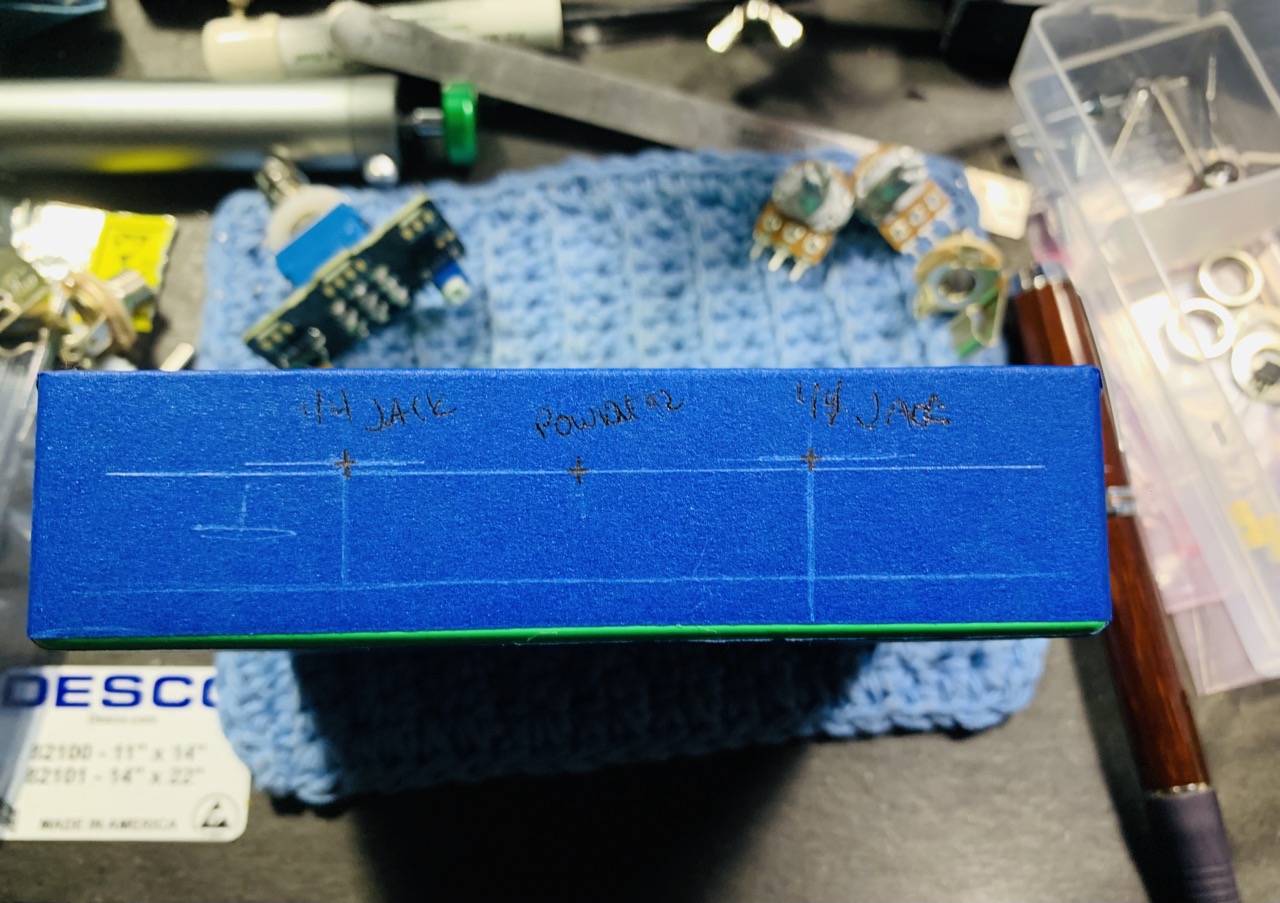
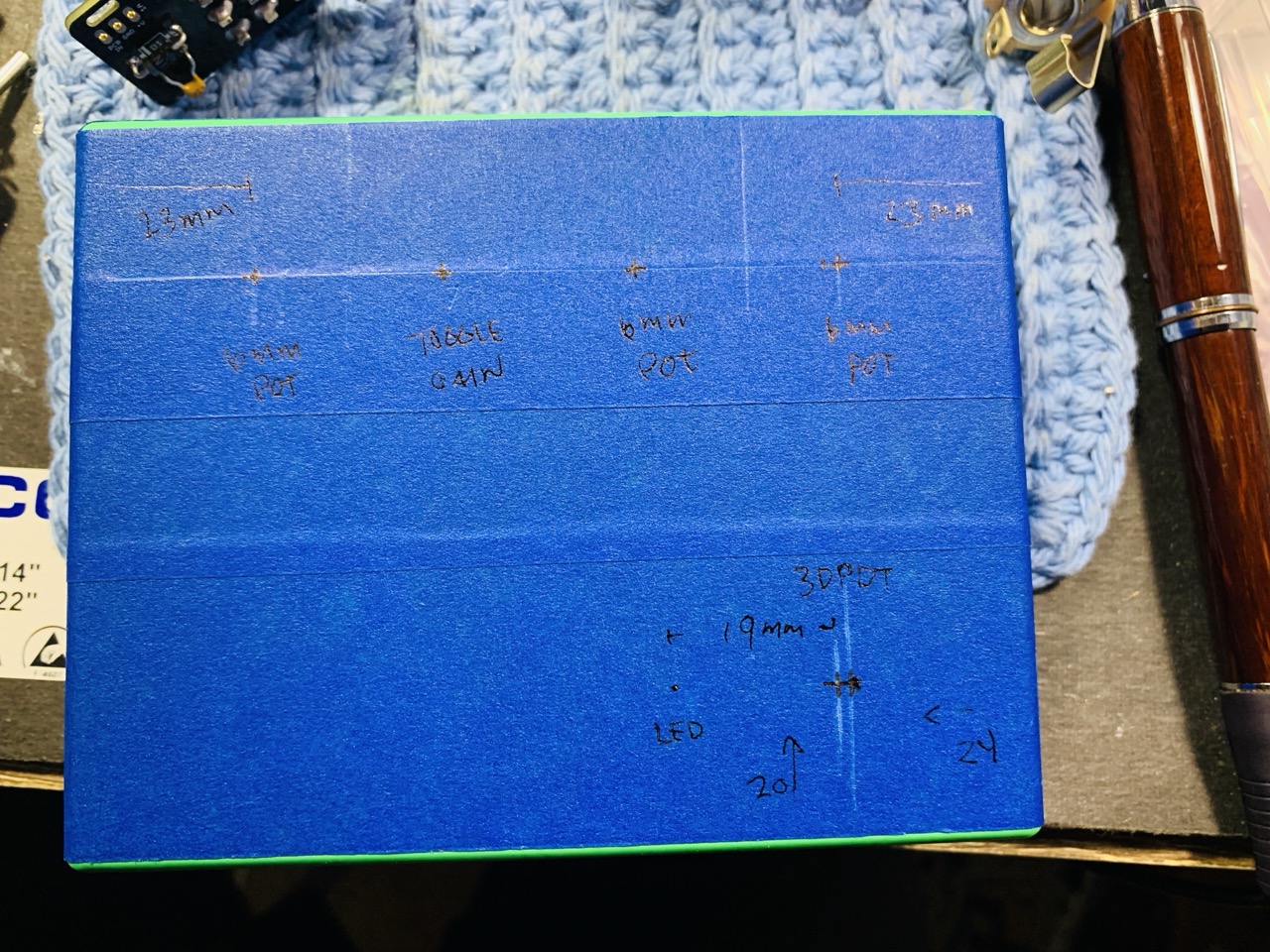
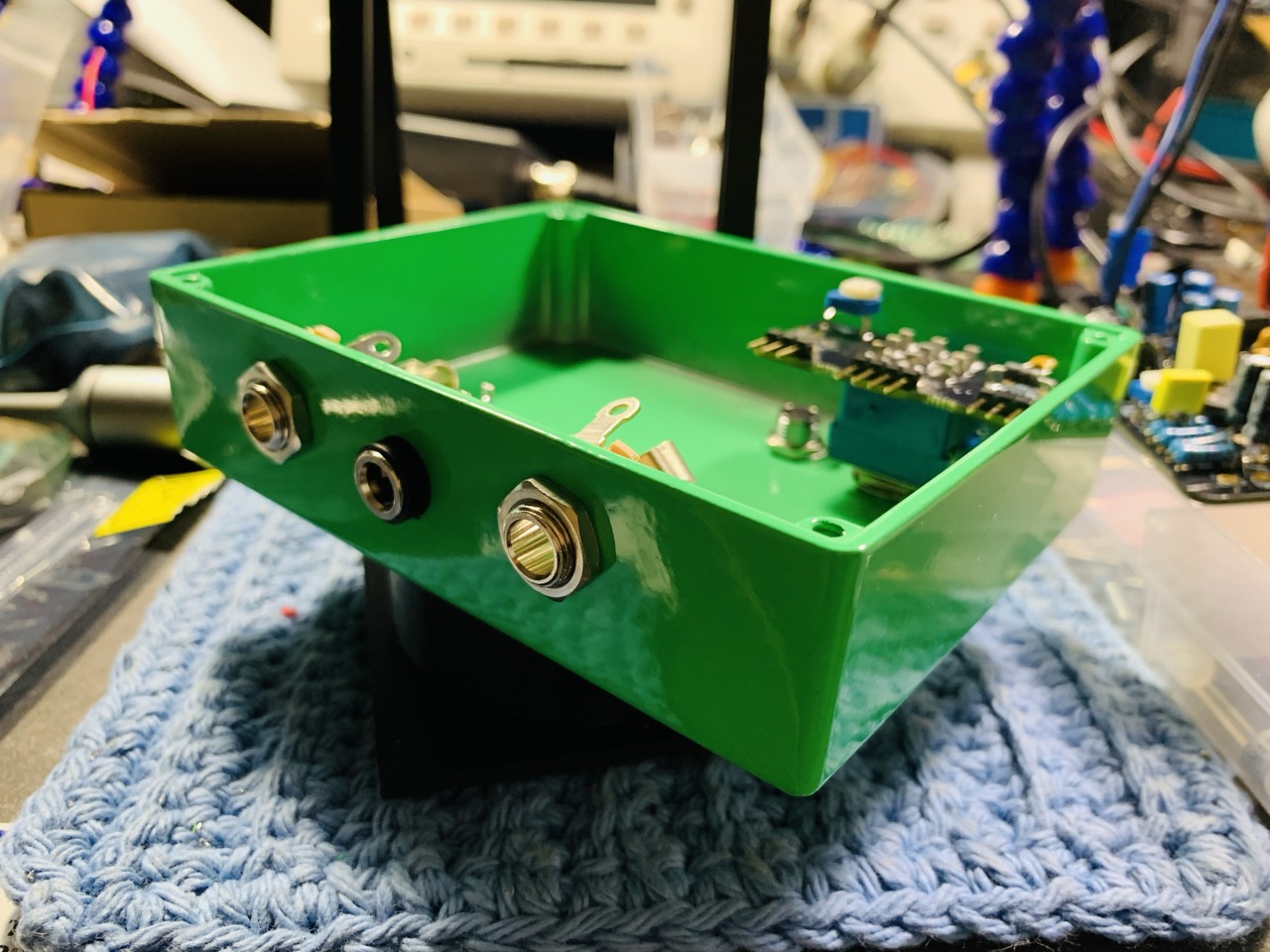
I largely replicated the Hudson Broadcast (non-boost, 24V version) in knob and gain switch location. For input/output jacks and power, I located those in a more typical top-side input design style.
One thing to note on layout in regards to knob(s):
- LEVEL and LOW-CUT are swapped on my pedal. I used the LEVEL pot as a natural stand off for the PCB so I didn't have to design and 3D print a raised mount.
|
|
|
Soldering & Assembly
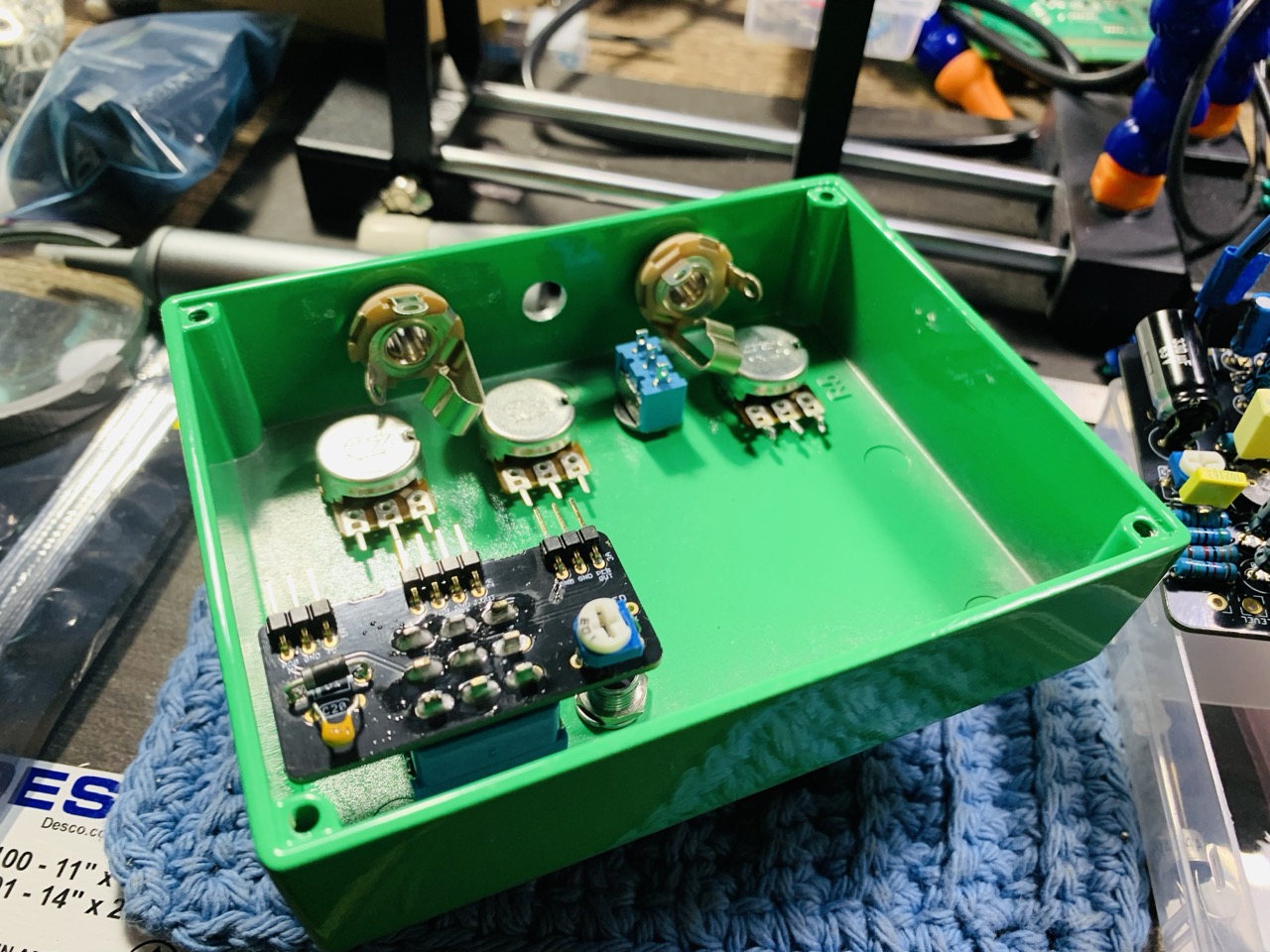
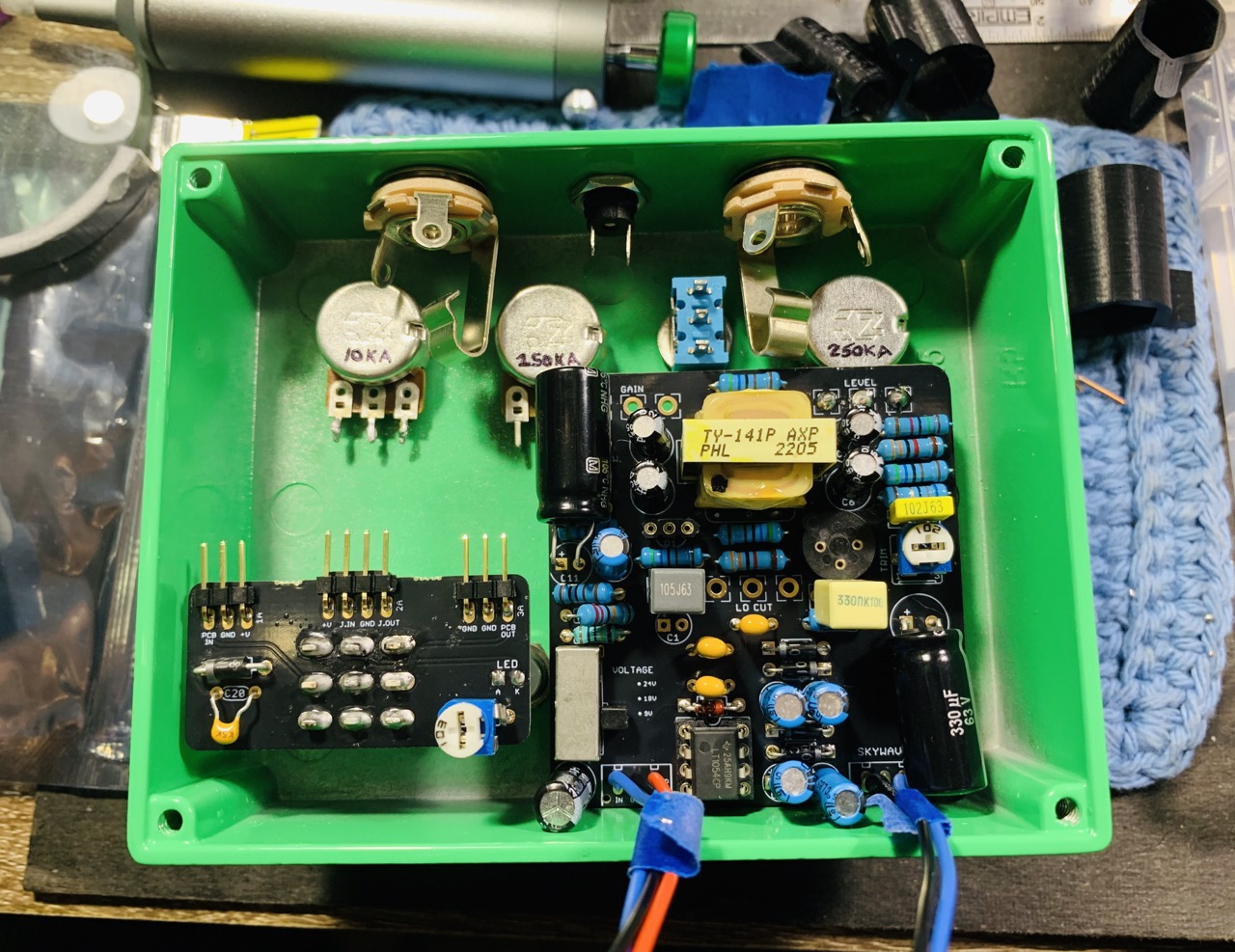
All dry fit and hope it all goes to plan!
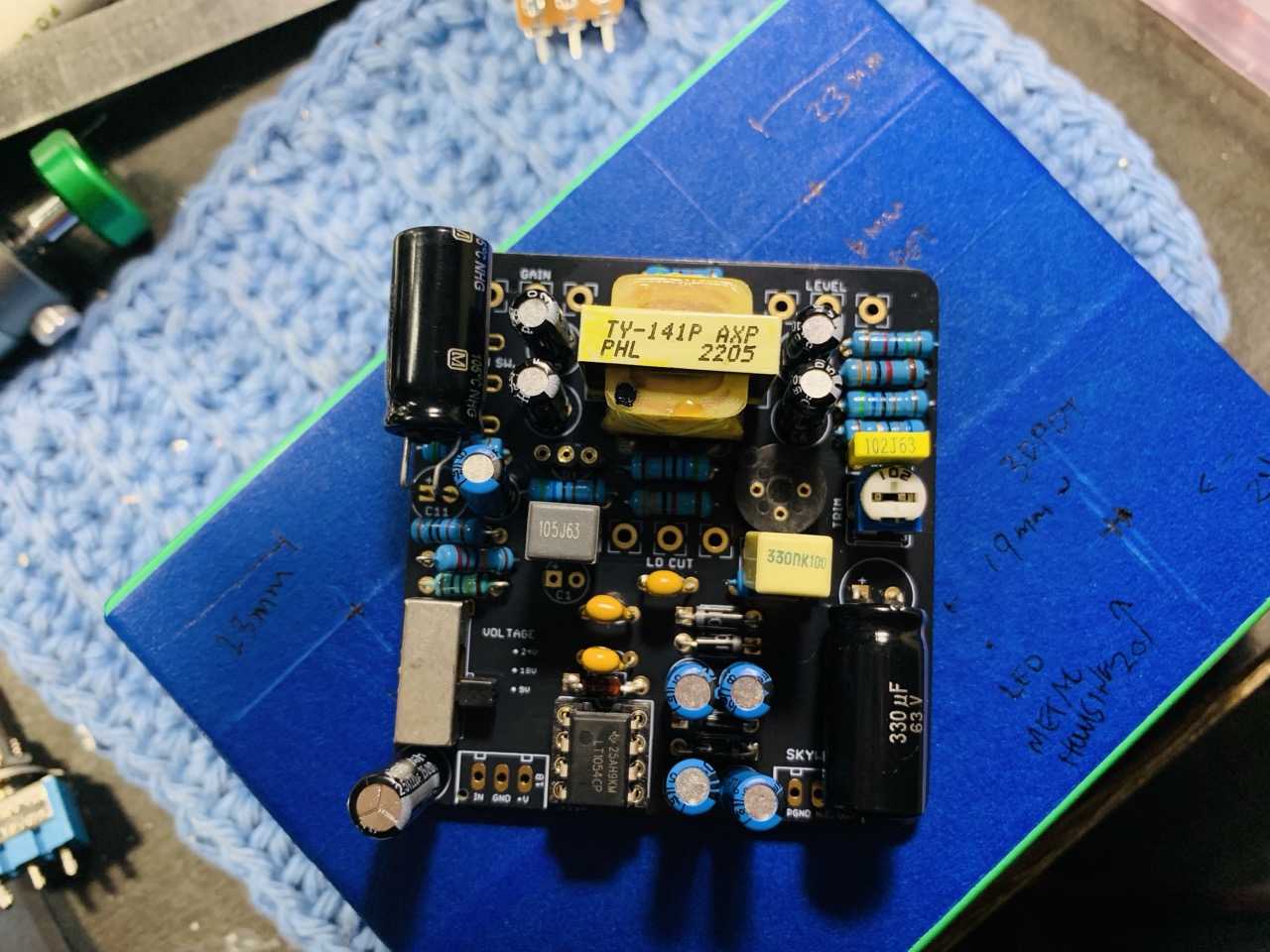
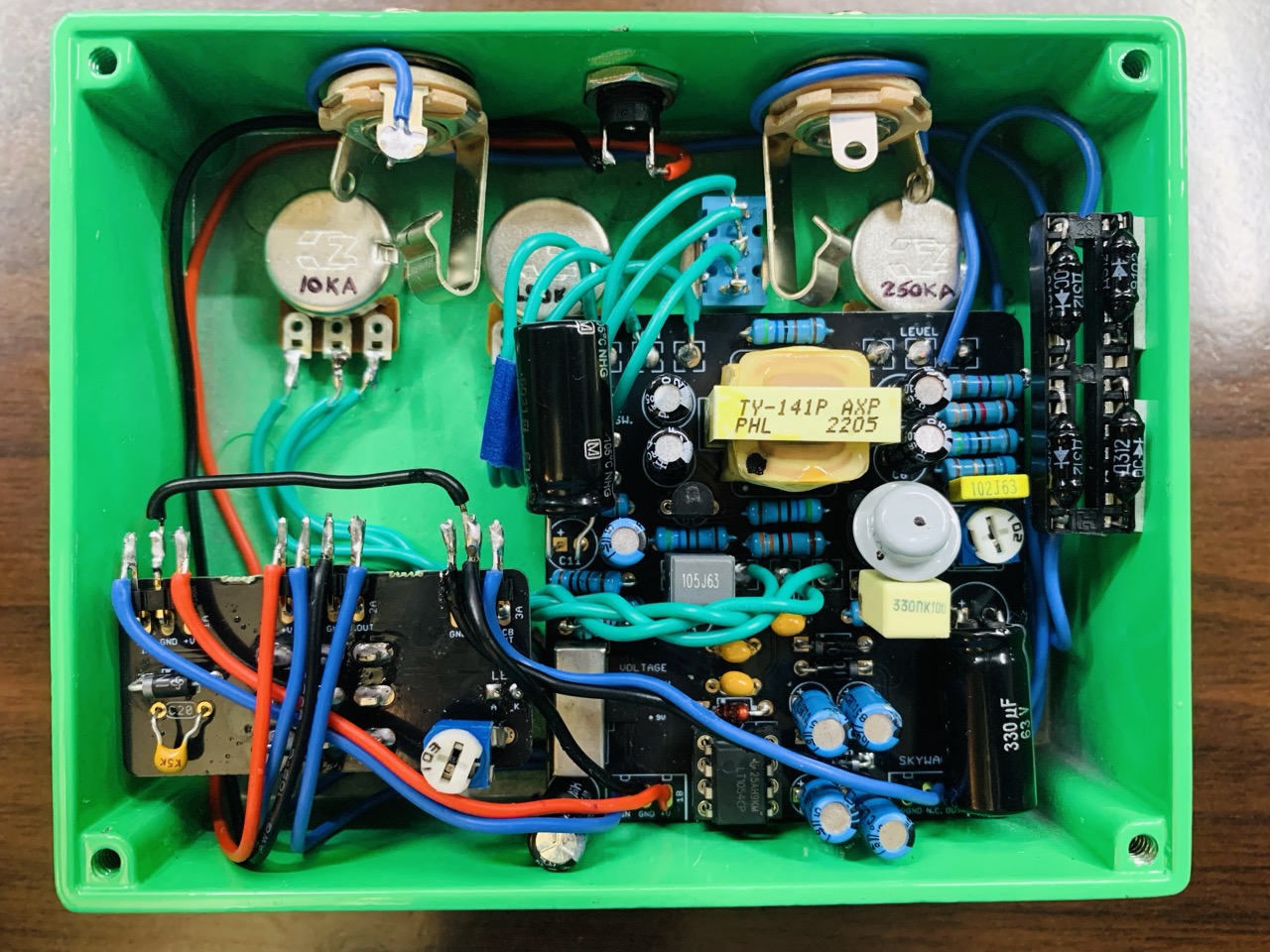
I will say: this is packed. If I have to work on anything that's outside of the socketed transistors or clipping diodes, it all has to come out.
A few things of note:
- Transistor(s) are both socketed.
- Clipping diode(s) are all socketed in a 20-pin IC socket
- Mix of 1/8w and 1/4w resistor(s) (using on-hand inventory), so you'll noticed the right-angle mounting tactic
|
|
|
|
|
The Pedal
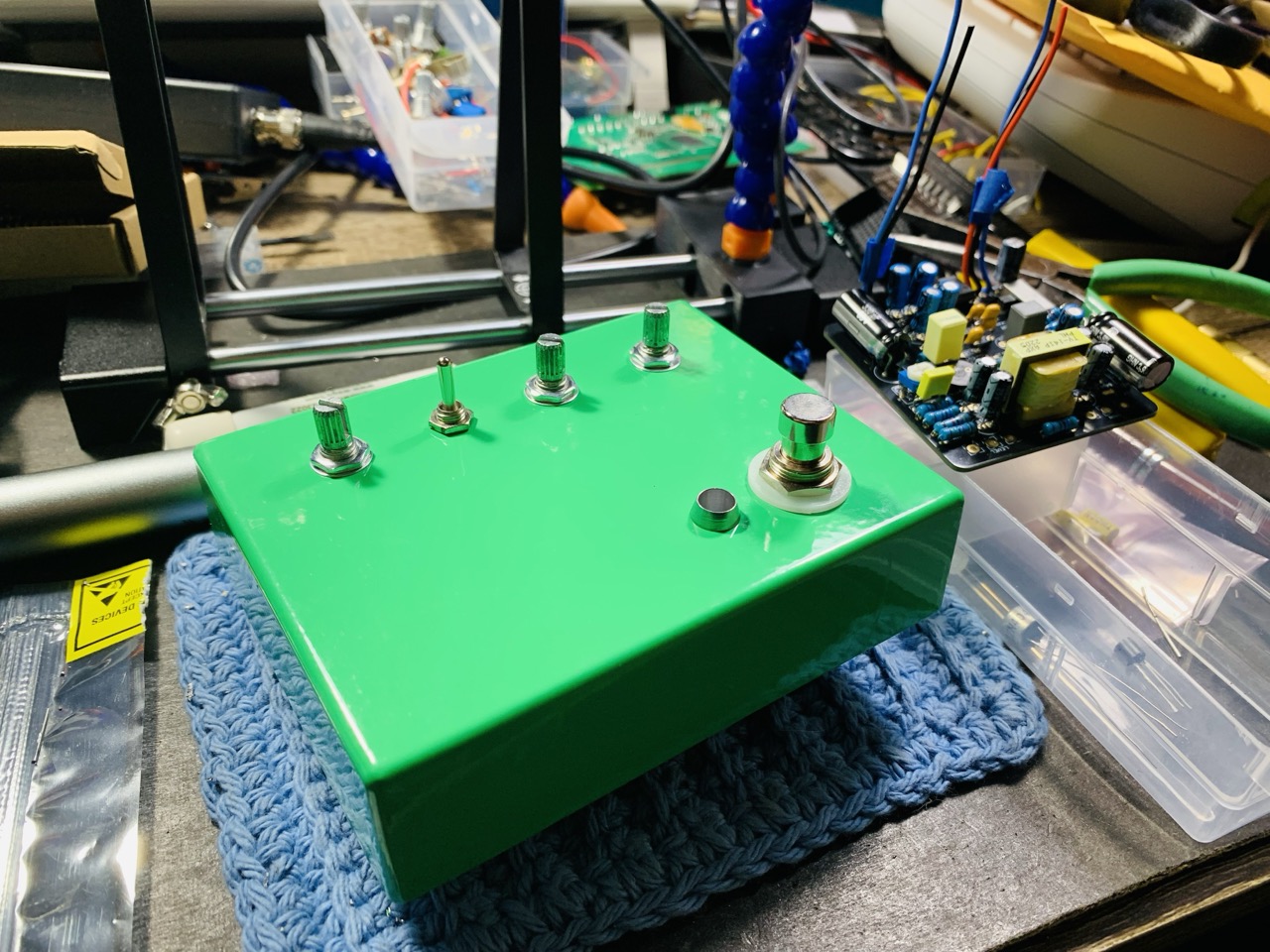
The final Hudson Broadcast clone pedal completed, check it out:
|
|
|
Take-aways
Transistor Choice(s)
Using the Grey-bench Electronics Hudson Broadcast teardown, I was comfortably able to get a pretty good place to start for transistor measurements.
I'll cut to the chase: I was not impressed with the 2N404A. I serendipitously almost nailed the exact specifications of my BC547C (hfe=514) and 2N404A (hfe=213, vF=222mV) from the teardown, and it had a very thin tone. I'm not sure what the parasitic capacitance was on that transistor, but it also was very treble-centric and almost too bright. I almost thought it was "too much" in terms of raw distortion/fuzz characteristic.
I think I rotated through every germanium PNP I have in my possession (15+), and two definitely just blew me away (with a low 3rd place):
- 1T320B - a Russian NOS, middle range hfe (~60-130) and leakage, but the tone and compression coming off these none of the 14+ others I have could even match. This... was the "this is it" one. What a "fat" sounding tone I get with lead and note work (hfe=80, vF=446mV)
- 2N1307 - This is a modern germanium. Now it's not 'that different' from the 1T320B, but it's detectable in edge and compression if you really pay attention. I'd say this is could be splitting hairs in terms of sonic pretentiousness, but if this was all I had, I'd roll with it (hfe=61, vF=316mV)
- 2N508 - This is a modern germanium. The gain and distortion are there, but compression is far different, I would describe it in that less tight distortion to fuzz category. It's a worthy choice if that's what you have (hfe=94, vF=364mV)
- 1T403A - another Russian NOS, lower hfe (~10-50) and leakage, but this had a more mid-range dull feel. The gain and distortion was still there, but felt a bit cold. This would work --- but it's distinguishable from the above two for sure (hfe=48, vF=122mV)
Clipping Addition (Explained)
One of the things I noticed with (my circuit) for the Hudson Broadcast, especially when I initially tested with the stock germanium (2N404A), when the GAIN switch is set to 'high' (up) and GAIN pot is heading towards 3/4 to full maximum, the buzzy-fuzzy and bottom end is so loose. If there was suppose to be any saturated compression from the transformer (as advertised), I certainly wasn't experiencing it. Even in a lot of the Youtube pedal demo's highlight this same artifact.
I was really researching other pedal schematics designs for days where a good place to implement some soft clipping to:
- Add some more compression and tightness to the bottom end when GAIN is heading to full/maximum
- Stick with the germanium theme (e.g. germanium diodes only, and preferably Russian since I chose the 1T320B)
- Do not alter the Hudson Broadcast characteristics and sound (e.g. don't hard clip and turn it into a tight distortion or overdrive pedal)
- Don't do anything to 'drop' the signal for perceived volume drop
I chose R9 partly because it's a large enough resistor (15k) that the current across it, at 9V, 18V or 24V (largely only concerned with 18V) will be, according to Ohm's law:
9V -> 15k     ~0.6mA
18V -> 15k    ~1.2mA
24V -> 15k    ~1.7mA
With the paired in-series diodes, they measures at ~0.435mA. There is plenty of current available not to cause anything I've outlined, if anything it should result in, at least, a slightly "boosted" signal.
How does it sound?
I would say, this Hudson Broadcast is as-advertised. Man, it really shines. I'd say, it's a really versatile controlled pedal; you can interchange VOLUME and GAIN to get a more distortion/fuzz vs overdrive. Then if you really want to tighten up the overdrive, just keep increasing LOW END (which is decreasing). It can pretty much nail Ted Nugent Strangehold studio tone (albeit a bit more modern) and anything early Deep Purple out of the gates.
I would highly recommend a clean boost in front of it --- this is where the Broadcast shines. In combination with any sort of buffer in front of your clean boost (I am using a Fulltone 2B clone with a TL072 buffer), although not mandatory, but you will tell the difference. You can go right into a distorted but not necessarily 'modern' rock tone --- it's still very much a modern-classic tone but teeters on that fuzz side at times, especially in power chords. But with the clipping, it's not so buzzy and loose.
And, sure enough! The D312B's did not disappoint in the symmetric soft clipping, post-gain stage. It actually makes even setting the entire pedal (LEVEL, GAIN and LOW END maxed with GAIN switch at 'high') super fuzzy but entirely musically playable. And the advertised picking and lead note playing is still nice. It also added a very nice, warm (needed) professional edge to the tone, and that magic sounds GREAT for lead work. For chords, it added just a bit more compression that really nails that classic rock compression tone bite.
What I dont get from my Hudson Broadcast --- good (for me), bad or otherwise, is that thin, starved, farty-buzzy octa-fuzz sound here and here overly compensating on the far end of LOW END pot and maxing out everything. Does it make my clone something different now with that big of a transistor change and clipping? It makes it more musically usable imho. If someone wants a tone like that --- get an octiva like pedal. I wouldn't see anyone pushing a pedal like that for always-on use; it's "fun" once, but I'd also contend: it has to be insanely difficult to source and baseline parts in a pedal of this type. All the old NOS is getting harder to find, and what does surface is largely picked-over crap.
Lastly, do not be afraid to roll back your volume (single coil or humbucker), this pedal and circuit clean up SO WELL. If you're a "volume knob" player (like me) and do have rolling back and full on while you play, this responds so well to that.
Hopefully, in the near future, I can get some Soundcloud integration to post some clips.
Resources
- https://aionfx.com/app/files/docs/skywave_documentation.pdf
- https://aionfx.com/project/skywave-germanium-drive/
- https://youtu.be/V1bkVGt2yS4?si=yQxoEc6eRl1aYzHd
- https://youtu.be/1T-tM0ZqaYY?si=cA38_LH8H5WKVcJ7
- https://youtu.be/6G1jlvVjzzc?si=Cli7XC4bBpPTjENP
- https://youtu.be/0hrFv0J0Pco?si=QWb2wFibRzc-pcky
- https://youtu.be/XTYbi293VYc?si=PtyGCH2TXXS7vKlf
- https://tagboardeffects.blogspot.com/2016/12/hudson-electronics-broadcast.html
- https://effectslayouts.blogspot.com/2017/01/hudson-electronics-broadcast.html
- https://www.calculator.net/ohms-law-calculator.html
- https://www.youtube.com/watch?v=6G1jlvVjzzc